Friday, August 12, 2011

Slightly Off Topic...Famous Amos: Water Dog and Obsessed Retriever!

And now for something completely different. Well... it's still "Lights, Camera, Action!", only different.
Wendy and I were in Northern Michigan last week, and we took along our travelin' dog, Amos. He is a retriever in the truest sense. Maybe not a good hunting dog, but a retriever for sure.
And we discovered that Amos LOVES the water.

Amos. Photo: Wendy Wooley, Manual mode, 1/250 @ f/5.6, ISO 400, 35mm.
To get this shot you really need to be committed, and maybe we should be committed.
There are a several keys to getting this shot.

First, you may heard me quote my hero, Joe McNally, by saying "push in tight and shoot wide". You really have to get in their face when using a wide angle lens for a single subject. Our inspiration for this shot comes from Joe.

Secondly, for the photo to work, we needed to get Amos above the horizon line. Wendy is shooting from about one foot above sea level. This gives the subject some prominence.

Wendy had to be committed to this shot. Photo: Matt Wooley, Manual, 1/100 @ f/10, ISO 400, 70mm.

The third key is the off camera flash. In this case we are using pocket wizards to fire a Canon speedlight on a mini lightstand. Check out this previous post for more ideas on off camera flash.
We also wanted to give the light some warmth to match the sunset. An orange plastic poop bag wrapped around the flash did the trick. And... it kept the rig dry!

Amos, set to retrieve! Photo: wendy Wooley, Manual mode, 1/250 @ f/8, ISO 400, 35mm.
Our best pictures came after the sun had set. Water has a wonderful reflective quality that increases the available light. The shot just would not look the same on a grassy lawn.

The forth key is to shoot in Manual Mode. When using a flash, shoot in Manual. Just do it. Always.

We set the exposure for the sky, f/8 at 1/250th. Checking the Exposure Meter through the viewfinder, the reading is -2 or lower. Perfect for color in the sky.
The flash fills the subject with a pop, and we have a picture. Without the flash, all you would have is a silhouette of leaping Amos.
In this case, our flash is also set on Manual at about 1/2 power.

My job was to keep Famous Amos focused. Not too hard with an obsessed retriever. Amos said it was his best summer vacation EVER!

The last key is warm water. Northern Michigan is beautiful, and has been home for Wendy for the last 7 years. I guess she must see something in me and the Bluegrass to pack it all up and move to Kentucky.... I'll do my best to be worth the trouble.
We plan to return to the North regularly. 


Capture the Light Equine is pleased to announce our Fall Bluegrass Equine Photography Workshop!
We had such positive response from our Spring Workshop, we are doing it again November 1-3. Conveniently planned for the week before the Breeder's Cup, this class will be limited to 9 participants with 3 EquiSport instructors. We will visit some pretty cool spots in the Bluegrass for equine photography, like Old Friends, Keeneland, Kenny McPeek's training center, and Spendthrift Farm. Check out the details and drop us a line!

Sunday, July 31, 2011

New Photo Tricks with Old Friends

The way it works most of the time is..  you get some nice light, but you just need to find something interesting to put in there with it.
It promised to be a nice sunset last night, so Wendy and I headed out to Old Friends Retirement to find some unsuspecting subjects. We found the perfect volunteer in Marquetry.

A little more about Marquetry from the Bloodhorse, "Bred by Prince Khalid Abdullah’s Juddmonte Farms, Marquetry raced for Juddmonte alone and in various partnerships. He captured three grade I stakes, including the 1991 Hollywood Gold Cup, and retired with earnings of $2,857,886."
Read more here.

Marquetry at Old Friends. Photo: Matt Wooley, Aperture, F/5 @ ISO 800, 1/1000th, -1/3 EV, 300mm.

 Marquetry was a more than willing to have his picture taken. I can't really recommend getting out in the paddock with a stallion you don't know, but the 24 year old retiree followed me around like a puppy dog. Well.. I had mints.

I started off with a long lens, the 300mm in the above picture, to compress and control the background. I was 60 feet away for this shot.


The obvious key to good backlighting is to have the subject somewhere between the camera and the light source. But what really makes the backlighting effect work is to ALSO find a dark background.
In this case, the sun is coming in over the dark trees, hitting the horse from behind. Be careful you don't let the direct sun hit your lens, use a lens hood to control flare.

I then went to the other extreme with the 16-35mm. My thought with the wide angle was to "push in tight and shoot wide" as Joe McNally  would say.

Marquetry at Old Friends. Photo: Matt Wooley, Aperture, F/8 @ ISO 800, 1/1600th, -1/3 EV, 16mm.
By pushing in tight with the wide angle lens, you give your subject prominence. I've added to that effect by shooting from a low perspective, placing the subject partly above the horizon line. The deep Aperture, and negative Exposure Value, give me nice color.

Remember to "look both ways". As the sun drops a little lower, I use the wide angle to get a little color from the sun. I'm still at f/8 and -2/3 for this shot. 

Marquetry at Old Friends. Photo: Matt Wooley, Aperture, F/8 @ ISO 800, 1/800th, -2/3 EV, 24mm.
Again, I push in tight and pop the horse above the horizon line. I was about 6 feet from Marquetry for this shot. The sun is not so hot now and partly obscured, so with the sun hitting the lens I get some "creative" lens flare.

Don't be afraid to try things to see what works. I shot over 250 frames in about 20 minutes, and ended up with 9 that I liked well enough to put up on the EquiSport Photos website.

Marquetry at Old Friends. Photo: Matt Wooley, Aperture, F/8 @ ISO 800, 1/1000th, -2/3 EV, 24mm.

Meanwhile, Wendy was focusing on Afternoon Deelites.

From the Bloodhorse, "During his racing career, Afternoon Deelites was trained by Richard Mandella for owner Burt Bacharach. He was an instant success, winning his first three starts as a 2-year-old, including the Hollywood Futurity (gr. I) and Hollywood Preview Breeders’ Cup Stakes (gr. III)."
Read more here.

Afternoon Deelites at Old Friends. Photo: Wendy Wooley, Aperture, f/5.6 @ ISO 500, 1/500th, -1/3 EV, 100mm
Don't think you have to quit shooting just because the sun has set. The twilight sky makes a golden opportunity for a story telling silhouette shot. Here Wendy has "exposed for the sky" by locking in a "fast enough" shutter speed. The negative Exposure Value helps add color.

Learn to use the "Exposure Lock" button on your camera to expose for the sky. While in Aperture Mode, aim the camera at the sky, press the Exposure Lock button, then recompose your frame and take the shot. The result will be an image that is correctly exposed for the bright part of the frame, (the sky), and everything else rendered as silhouette.

Capture the Light Equine is pleased to announce our Fall Bluegrass Equine Photography Workshop!
We had such positive response from our Spring Workshop, we are doing it again November 1-3. Conveniently planned for the week before the Breeder's Cup, this class will be limited to 9 participants with 3 EquiSport instructors. We will visit some pretty cool spots in the Bluegrass for equine photography, like Old Friends, Keeneland, Kenny McPeek's training center, and Spendthrift Farm. Check out the details and drop us a line!

Tuesday, July 19, 2011

Hip Ideas for Horse Sales

Start to finish, the Fasig Tipton Sale in Lexington proved to be a marathon session for horse and human. Wendy and I spent a couple of long days on behalf of a client, documenting the color and commerce of the sales.
Our photos had to tell a story from show ring to sales ring. Here's what we ended up with.
 
Always focusing on key horses for the client, we started in the barn area. The horses, or "hip numbers" are led in front of prospective buyers, which also provides us the opportunity for a shot of the scene.

Hip #124 Orientate - Storm Strip '10, Photo: Wendy Wooley, Aperture Priority, f/3.5 @ ISO 400, 1/2500, 0EV, 100mm
 During slower periods, we shot conformations and head shots. These guys are yearlings, and we are in a VERY distracting environment. So don't have the ability to set the feet, they need to be "walked into" conformation. An experienced groom is essential for getting good results. Wendy is just off camera left, getting the horse's attention.

Hip #221, Giacomo-Classy Assets '10, Photo: Matt Wooley, Aperture Priority, f/4 @ISO 250, 1/800, EV -1/3, 135mm
My main thought here is to blur out the background, so I'm shooting in Aperture Priority at f/4. I adjust the ISO to get a shutter speed that is "fast enough". Notice also that I chose a fairly long focal length with my trusty 70-200 f/2.8 for compression, and keep my perspective from a low angle to give the horse added prominence.

While we are at it, we grab a head shot, also at f/4.

Hip #221, Giacomo-Classy Assets '10, Photo: Matt Wooley, Aperture Priority, f/4 @ISO 250, 1/1000, EV -1/3, 185mm

Tuesday is Sales day, and we know it's going to be a long one.
Wendy sets up in the back of the sales ring on a tripod and an 85mm. She avoids "Camera Shake" by using a Cable Shutter Release so she never has to touch the camera while taking a picture.

Hip #166 Notional - Your's Truly '10, Photo: Wendy Wooley, Manual Mode, 1/200 @ f/2, ISO 1600, 85mm
I tend to roam around getting different perspectives. I'm still using the 70-200mm, but I crank the ISO way up, knowing the Canon Mark IV will reduce the noise.
I set the camera to AI Servo focusing and Burst mode. I also switch on the Image Stabilization (IS) on the lens. The IS helps stop Camera Shake for me since I'm handholding the camera, but it will not stop a moving subject. So I take a burst of shots as the horse pauses.

Hip #231 Malibu Moon - Dance darling '10, Photo: Matt Wooley, Manual Mode, 1/200 @ f/3.2, ISO 2000, 200mm
We always shoot in low light (or flash) conditions in Manual Mode. We want to control both the Aperture and Shutter Speed. Adjusting the ISO gives the correct Exposure. The exposure meter might be reading -2/3 through the viewfinder... but that is the correct exposure, that's what it looks like in the room.

Those are a couple of ideas for capturing the feel of the Horse Sales. Send in a comment or question if you have one, and I will get an answer to you.

Capture the Light Equine is pleased to announce our Fall Bluegrass Equine Photography Workshop!
We had such positive response from our Spring Workshop, we are doing it again November 1-3. Conveniently planned for the week before the Breeder's Cup, this class will be limited to 9 participants with 3 EquiSport instructors. We will visit some pretty cool spots in the Bluegrass for equine photography, like Old Friends, Keeneland, Kenny McPeek's training center, and Spendthrift Farm. Check out the details and drop us a line!

Sunday, July 3, 2011

Awesome Photo Shoot!

Awesome Again that is.
Adena Springs Farm, one of our favorite clients, called us in need of some fresh Stallion photos. It seems it was time to update "The Look". Not that the Stallions don't speak for themselves, Adena has been the leading Thoroughbred breeder worldwide for about the last decade.
So, over the past couple of weeks, Wendy and I have made a half-dozen trips out to the Paris, Kentucky farm. Bill Drury, the stallion manager is always happy to see the photographers coming...lol.
It only means that the boys need to get their baths, dried off, manes brushed, tails pulled, hooves dressed and halters cleaned. All pimped out for pictures. For 6 stallions. The crew really loves it when we show up.

Awesome Again at Adena 6.30.2011. Photo: Matt Wooley Aperture Priority, f/8 @ ISO 500, 1/800th, 0EV, 200mm

We were looking for something a little different than we had done before. I'm learning that just because I might be decent at a certain shot, doesn't mean it is for everyone. Each farm wants to have their own "look".
After supplying a few different ideas, the farm chose the distant barn shot as an iconic Adena symbol. I'm working in Aperture Priority here at f/8. I don't care what the shutter speed is, as long as it's "fast enough". My goal, with f/8, is to have a good depth of field and good color.
With my in-camera EV set at 0, I am actually underexposing the horse, but I have good color in the sky and background. I know that I can selectively bring back the detail of the horse in Lightroom with the adjustment brush. I shoot EVERYTHING in RAW, by the way.

I added about 1/2 stop of Exposure, and some Brightness to the horse in Lightroom.
Wendy and I shoot a few different scenes for each horse to give our client some choices. Between us we take about 300 shots of each horse in hopes of putting 15-20 in a gallery for the client. This often takes multiple trips to the farm.

Awesome Again being led out to the paddock. Photo: Matt Wooley, f/5 @ ISO 400, 1/1600th, -1/3 EV, 300mm.
The paddock shots are our favorite. Wendy is shooting on a ladder from one corner with her 500 f/4 and I'm shooting from another angle with a 300 f/2.8. I'm still in Aperture Priority for this, to blur the background a little more... and I bump up the ISO so the Shutter Speed is "fast enough". We get a variety of head-on and side shots, both vertical and horizontal, while trying to eliminate any distracting backgrounds.

Awesome Again paddock shot. Photo: Matt Wooley, f/5 @ ISO 400, 1/1600th, 0 EV, 300mm.
One of my hardest lessons has been learning to NOT crop my images too tight (see above). The client needs room to add text in an ad, or they may want it cropped differently. They can judge the merits of the photo without me cropping it in tight.

On a separate trip we photographed Einstein's new Conformation shot. After supplying the client several proofs, the shot below was selected. I removed the horse's shank and a background driveway from the finished picture in Photoshop.

Einstein conformation. Photo: Matt Wooley, f/5 @ ISO 320, 1/1600th, 0 EV, 100mm.
 I shoot conformations in Aperture as well. F/4 to F/5 is a good depth of field to insure sharpness front to back on the horse, while blurring the background so the horse pops out.

We also shot a portrait of Einstein. This is the "Old Style" that the farm is moving away from.

Einstein portrait. Photo: Matt Wooley, f/5 @ ISO 320, 1/500th, -1 2/3 EV, 115mm.
We placed the horse in front of the doorway to the breeding shed, just out in the sunshine. The Negative Exposure Value makes the already dark background go black.
In both shots above Wendy is holding a gold reflector to throw a little light into key areas.

We love to hear your comments! Or if you have a question, send it in and I will try to answer it.

Capture the Light Equine is pleased to announce our Fall Bluegrass Equine Photography Workshop!
We had such positive response from our Spring Workshop, we are doing it again November 1-3. Conveniently planned for the week before the Breeder's Cup, this class will be limited to 9 participants with 3 EquiSport instructors. We will visit some pretty cool spots in the Bluegrass for equine photography, like Old Friends, Keeneland, Kenny McPeek's training center, and Spendthrift Farm. Check out the details and drop us a line!

Friday, June 24, 2011

Remote Possibilities

"Wow! How did you get that shot? It looks like the horse is going to run over you!"
The short answer is "Just stick your camera in the dirt, and fire it with a remote".

Giant Oak (outside) wins the Clark H. at Churchill 10.26.2010. Manual priority, 1/1000 @ f/3.2, iso1250, 200mm
Wendy and I headed out to Stephen Foster Stakes Day at Churchill Downs last Saturday, for what promised to be a nice card and a nice day. After our schedule over the last few weeks, it sounded like fun in the sun.
And me just being me, I wanted to challenge myself to get something a little different... so I brought out the whole kit.

Dr. Ballenger wins at Churchill 6.18.2011. Photo: Matt Wooley, Shutter Priority, 1/1600 @ iso500, f/4.5, +2/3ev, 200mm.

My buddy Alex Evers, a contributor here on CTL Equine, got me started on "remotes" a few years ago. Seeing some of his unique perspectives got me hooked on the possibilities of placing cameras in some unusual spots. Like under the rail at the race track. Or in the starting gate. Or in the overhead trellis at a wedding!

Having the ability to use remotes gives you the chance to get the action from multiple cameras, and therefore multiple perspectives. The photo below frames an iconic backdrop at Churchill Downs.
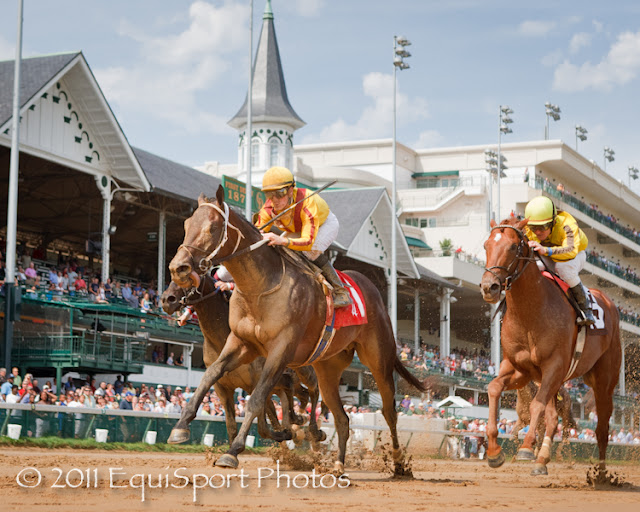
Dr. Ballenger wins at Churchill 6.18.2011. Photo: Matt Wooley, Shutter Priority, 1/3200 @ iso800, f/4.5, +2/3ev, 50mm

The possibilities are endless. If you can stuff a camera in a spot, you should be able to get a picture from that perspective.

Dr. Ballenger at Churchill 6.18.2011. Photo: Matt Wooley, Shutter Priority, 1/3200 @ iso800, f/4.5, +1/3ev, 15mm fisheye.
Remotes are also great for CYA, (cover your ass). Wendy and I both shot this race hand held as well, she with a 500 on the outside and me with a 300 inside, and went in tight on the #13 horse. Unfortunately for our photos, Dr. Ballenger ran him down at the wire from the outside.

Have I mentioned I'm a "Home run, or Ground Out" kind of shooter? I'm always swinging for the fence. In this case, we both got really nice tight shots... of the second place horse. Ground out. The remotes saved us!

So here's the set-up. Most of the time I will use a set of Pocket Wizards. These units can be set to send or receive a radio signal from another Pocket Wizard.

Pocket Wizard "Multi-Max" in the Receiving camera's hot shoe.
A special cable is required. This one is a Canon '3-pin plug to mini-microphone', with an inline pre-release switch. You can turn the pre-release on to keep the camera "awake" so it fires instantaneously, or leave it off to allow the camera to "sleep".


The other Pocket Wizard can be mounted in another camera hot shoe, and will trigger as the other camera fires, or it can be triggered by hand.
This photo is in our back yard, with the cameras about 3 feet away from each other, but the range for Pocket Wizards is supposed to be 1600 feet. Not too sure I would count on that distance, but they are definitely reliable from the other side of the race track. 
I tend to hold the triggering PW in my left hand, because I don't always want the remote to fire every time I hit my hand held. Plus, I'm usually firing cameras that have different frame-per-second firing rates.


 Here's what the set up looked like last Saturday at the track...
The first photo was taken with the 2-camera set-up. Both are set at 200mm, one is an "innie" and one is an "outie", so I should get a nice tight frame wherever the horses run on the track. Got it with the "outie" this time since the horse ran wide. Did I mention that I missed it with my hand held?

 
 The second photo was taken with the "wide angle" remote. As always, I frame the background (in this case the grandstand), and preset a focal plane for the horses to run through. Notice in the photo info that I set this camera to fire 1 stop faster, 1/3200. The horses are running across the focal plane in the wide angle shot, rather than straight into the camera with the 200mm zoom, so the wide needs to be fast.


The third shot was taken with the fisheye. I used a Magic Arm clamped near the finish line. 
Tip: Do Not clamp to the mirror or any timing devices at the track...lol. 


This Magic Arm and Super Clamp will go about anywhere you can imagine. Like on the starting gate, or the photographer's stand. Or above the trellis at a wedding...


Or under a Steeplechase jump...

Steeplechase at Ky. Horse Park. Photo: Matt Wooley, Shutter Priority, 1/2000 @ iso500, f/4.5, +1/3ev, 16mm.

One of the keys for remotes is setting a focal plane. I pre-focus on a point at which I think the action will occur. Switch the lens off to Manual Focus, so it does not try to Auto-focus during the shot. Then fire on Burst Mode as the action occurs. In horse racing, if I'm preset on the finish line, I'll fire a burst of about 30 frames (at 10 frames per second) as they cross the wire. My goal is to get 2 or 3 frames that are sharp, enabling me to pick good foot position.

Okay, those are some of the basics. There is a LOT to learn about remotes, and a lot that can go wrong. But coming away with a really unique shot is definitely worth the effort. If you want your stuff to look different from everyone else on the sidelines with a camera, give it a try!
To get started you will need, at minimum, 2 Pocket Wizard Plus II and a Release Cable (for Canon). Total investment about $450. An upgrade to the PW's that I like, is the Pocket Wizard Multi-Max.
At big events we "hard wire" the remote cameras using lamp cable, since there is so much radio interference from cell phones and TV transmission, but the Pocket Wizards are good for 90% of the time. 

We love to hear your comments! Or if you have a question, and I will try to answer it.


Photo: Alex Evers.
Capture the Light Equine is pleased to announce our Fall Bluegrass Equine Photography Workshop!
We had such positive response from our Spring Workshop, we are doing it again November 1-3. Conveniently planned for the week before the Breeder's Cup, this class will be limited to 9 participants with 3 EquiSport instructors. We will visit some pretty cool spots in the Bluegrass for equine photography, like Old Friends, Keeneland, Kenny McPeek's training center, and Spendthrift Farm. Check out the details and drop us a line!

Sunday, June 5, 2011

Macho Uno... Portrait Session

EquiSport Photos has been on location this past week for one of our favorite clients, Adena Springs in Central Kentucky. Some pretty high profile stallions live there, like Kentucky Derby winner Giacomo, top producer Awesome Again, Ghostzapper and Einstein.. one of the smartest horses out there. They also happen to be some of the best cared for horses on the planet!

Bill Drury (left in photo below with khaki cap) is the stallion manager, he always looks forward to our visits...lol. Parading the boys out to the paddock is just what he needs on a 90 degree June afternoon after a busy day in the breeding shed. But he always seems to have a smile on his face, and a cheap cigar between his teeth.

Wendy and I needed to produce a variety of photography for an upcoming ad campaign, from portrait and paddock, to scenic farm shots.
This is the scene for one of the portrait shots of Macho Uno, He is the sire of Mucho Macho Man... one of the Belmont Stakes favs.

Mucho Macho Man stands for a portrait at Adena Springs Farm. Photo: Wendy Wooley
6 of us are involved with the shot. 2 grooms handle the horse. Bill and an assistant get the horses attention. Wendy got this shot, and she handles the reflector duties. All I have to do is work the camera!

Macho Uno. Photo: Matt Wooley 1/1000 @ f/5, ISO 200, -1 EV, 150mm
 I'm working in Aperture Priority for this type of shot. To get this shot I set it on f/5 to get the right depth of field, and just adjust the Exposure Compensation dial until the background goes dark. We have talked about "riding the exposure dial" in a previous post. I want to get just a few Highlight Alerts on the white horse. If I had left the EV at 0, I would have a mucho blown out horse against the dark background. Notice my low perspective, I don't want the hip too high.
The photo that was submitted to the client was not cropped this closely. One of my hardest  lessons is learning to leave the final crop to the graphic designer. They will often need room for text in a full bleed ad or may want to add a gradient layer to resize the image.

Macho Uno. Photo: Matt Wooley 1/1600 @ f/5, ISO 200, 0 EV, 150mm


This is the shot the client selected. Again I have cropped it in a bit, more blue sky will be added as a gradient to the top, to make this a full page vertical spread. F/5 is a good aperture here as well, it keeps the focus on the horse. I'm shooting with a 70-200 at 150mm to compress the image, making the distant barn more prominent. 

Then it's out to the paddock. Wendy uses the 500mm and I have the 300. We are strategically placed for the best light. The groom walks the horse across the paddock and turns him loose. The stallions always have a bit of run in them after being in the stall.

Mucho Uno. Photo: Matt Wooley 1/2500 @ f/5. ISO 400, 0 EV, 300mm
I stay in Aperture for the paddock shots too. F/5 works well for keeping the entire horse sharp, and blurring out the distracting background. I raised the ISO to keep a good fast shutter speed.

It pays to keep an eye out to the adjacent paddocks when working on the farm. Wendy got this great shot of Giacomo doing his best "Bobby Badass" imitation.

Giacomo. Photo: Wendy Wooley 1/5000 @ f/4.5, ISO 640, 0 EV, 500mm

Capture the Light Equine is pleased to announce our Fall Bluegrass Equine Photography Workshop!
We had such positive response from our Spring 2011 Workshop, we are doing it again! Conveniently planned for the week before the Breeder's Cup, this class will be limited to 9 participants with 3 EquiSport instructors. Check out the details and drop us a line!

Tuesday, May 17, 2011

Go Animal!

ANIMAL KINGDOM, 20-1 winner of the Derby, came out in good order, and is now the likely favorite for the Preakness. The Leroidesanimaux colt is feeling quite at home in his new Fair Hill surroundings, and will likely ship into Pimlico the morning of the race.

Animal Kingdom wins the Derby 5.07.2011. Photo: Matt Wooley/EquiSport Photos 1/1000 @ f/4, iso 1600, 300mm

Animal Kingdom wins the Derby 5.07.2011. Photo: Wendy Wooley1/1250 @ f/4.5, iso 1250, 500mm

The Kentucky Oaks was won by PLUM PRETTY.
Plum Pretty wind the Ky. Oaks. Photo: Matt Wooley/EquiSport Photos 1/3200 @ f/2.8, iso 800, 50mm

Overlooked in most early Derby lists, Animal Kingdom took a less traveled path to the Derby. He had only 4 career starts and his last race was 6 weeks prior, a winning effort in the Vinery Spiral Stakes.

Animal Kingdom wins the Vinery Spiral Stakes . Photo: Matt Wooley/EquiSport Photos 1/3200 @ f/3.5, iso 1600, 15mm

Animal Kingdom spent the days before the Derby training on the polytrack at Keeneland.

Animal Kingdom at Keeneland

Next stop, The Preakness Stakes! Go Animal!